WHAT THE WORLD CUP TAUGHT MARKETING

#00
BY NICOLáS CARNEVALE

 5 minutes
What the World Cup taught marketing
In 2026, we came away from the World Cup with more lessons about brands and audiences than we’ve learned at many industry conferences. Between goals, technology, records, iconic celebrations, and a final that broke our hearts into a thousand pieces, the tournament left us with some major takeaways.
1. Audiences are done with what they can’t control
Frustration with ads you can’t skip has been growing for years, across every screen. According to GWI data compiled by Backlinko, 29.5% of internet users worldwide use some form of ad blocker — around 1.77 billion people. According to eMarketer and YouGov, more than half have installed one at some point. The moment technology gives people a button to say no, half the world presses it.
Live TV is one of the few places where that button doesn’t exist. Enter the damn cooling break: FIFA introduced a three-minute pause in all 104 World Cup matches, every single time — even when it was 24°C in Mexico City, the kind of weather where any grandma (“la la la la la”) would happily go out for a walk. People responded with the only thing they had left: mass complaints. The Athletic surveyed its readers, and 76.4% considered the breaks problematic and intrusive.
Every interruption has a tolerance limit, no matter how good the excuse behind it may be. That limit is defined by how much control the audience feels it has over its own experience. The less control you give people, the higher the price you pay for every extra second.
2. You have to catch the wave fast — but you also have to read it right
When the semifinal against England ended, a piece of paper was spotted taped to the opposing goalkeeper’s water bottle, with instructions for a potential penalty shootout. Less than 24 hours later, Cif, Farmacity, BBVA, and Quilmes had already put their own spin on the image. On the other side of the continent, more than twenty Mexican brands jumped on the “No inglés” meme ahead of the Mexico vs. England match.
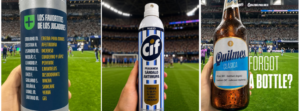
Both are masterclasses in timing: get the joke, translate it into your own brand voice, and publish while the conversation is still hot. No one waited for approval from three layers of management. The problem comes when a brand shows up three days late with the same idea half the continent has already seen: suddenly, the exact same move, instead of adding something, feels like Wi-Fi at a two-star hotel.
The lesson is simple: speed is the main ingredient, much more than a creative luxury that looks good in a portfolio. Without it, everything else shows up to a party that’s already over.
3. Sometimes it pays to play a different game
Levi’s Stadium and Gillette Stadium had to cover up their own names: neither brand was an official sponsor, and FIFA requires any non-sponsor logos to be removed. Levi’s responded by leaving the outline of its covered-up logo visible, alongside a sign that read something like, “Welcome to the beautiful (censored) stadium.” Gillette pulled a similar move, covering its logo with a piece of fabric shaped like shaving cream. For both companies, censorship became their most talked-about campaign of the year.
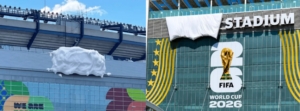
They took a restriction designed to keep them out of the conversation and turned it into the joke itself. They played a different game, on the same field, without paying the official sponsor price tag that Adidas or Coca-Cola did.
The lesson is simple — and pretty liberating: sometimes, all it takes is flipping the rule that’s working against you and turning it into an argument in your favor.
4. The connection matters more than the result
This World Cup marked Coca-Cola’s 50th year as a tournament sponsor, and instead of betting everything on the outcome, the brand created “All the Feels”, a global campaign designed to be there with fans throughout the tournament’s entire emotional roller coaster: the anticipation before a match, the euphoria of a goal, and even the heartbreak of a last-minute elimination. The official anthem, “Jump”, featuring J Balvin and Travis Barker, doesn’t mention a single team or trophy.

In our country, that campaign remained just as relevant with Argentina finishing as runner-up as it would have been if we’d been out celebrating back-to-back titles. That’s because it promised to be there for the full emotional experience of being a fan — heartbreak included — not just for the photo with the trophy. That was, quite literally, the deal.
The lesson for any communication plan tied to a sporting, electoral, or any other kind of outcome: a campaign that only works if the right team wins is a bet disguised as a campaign, not a campaign about the brand.
5. We always want to be like you, Messi
It still hurts deeply to see that photo of you, sitting alone on the pitch at MetLife, while all around you people celebrated something that broke our hearts just as much as it broke yours. And even with that image still fresh in our minds, the first thing we feel is gratitude — the same gratitude we’ve felt every time we’ve watched you play over the past twenty years.
Throughout the World Cup, as in the final stretch of your career, you stood out for scanning the entire pitch before deciding where to move. You calmly chose which plays were worth conserving your energy for and which ones called for rolling up your sleeves and driving the whole team forward. That composure, sustained even on the toughest afternoon, is something you can feel. It spreads. And it inspires admiration.
And there, with all due respect to the difference in scale, we see a very direct connection to our own craft. Not everything that makes noise deserves a reaction. Chasing every trend with the same energy is the marketing equivalent of running aimlessly after every ball: it drains you, scatters your focus, and rarely changes anything. Reading a trend well is, above all, knowing how to identify the ones that truly connect with what the brand has to say — and going all in only when they do. The rest, you let go without guilt.
The game we play every day
At their core, these five lessons are principles we apply at VEO to every brand strategy we build: read the moment, choose your battles wisely, and nurture a genuine connection over time.
Nicolás Carnevale
Copywriter